
The Zionskirche bells chime through the still Berlin sky. 3 workmen take note of the time and finish their coffee, pausing to allow a mid-30s woman pushing a pram past before leaving. The Milanese café owner takes his time to wipe down the table, as a squirrel races across the road opposite him. It’s 8 am in Prenzlauer Berg.
The former residential Bezirk for East Berlin labourers has had something of a makeover in 26 years. Football anthropologist Simon Kuper described Prenzlauer Berg, his former manor, in strong detail back in 1994. In his book “Football Against The Enemy” he details the squalid post communism conditions in which residents unwittingly receiving a new, free-market economic system longed for a return to the Leninist agenda. Bullet holes dating back to Soviet invasion some 50 years earlier and uninspiring drab housing. A stark contrast to the modern, trendy neighbourhood. The combination of easy transport access and low rents led the way for small businesses to pile in, bringing the mixed bag of gentrification and high living standards. This Stadtviertel is heavily branded as the ideal place to settle down and start a family. Sat here in 2017, you can really convince yourself that East Germany has moved in only one direction from the GDR shabbiness and glum.

However, among the oversubscribed Kindergärten and Thai restaurants lies something else. Prenzlauer Berg is home to BFC Dynamo. Currently occupying the niche as Berlin’s 3rd team, BFC Dynamo have a horrid, but deserved, image. They play mediocre and predictable Football down in the German 4th tear. Fans of good sport go to watch Hertha BSC. Seekers of authentic fandom go to watch Union Berlin. The only people watching BFC Dynamo are the bitter DDR nostalgists and right-wing skinheads. I recall youths in BFC fan-group attire openly singing on a train through the city;
Wir sind keine Fußballfans. Wir sind deutsche Hooligans!!
I am sure your GCSE German can provide a rough translation. They are the team you do not want to draw in the cup. They are the fans you expect trouble from. BFC Dynamo have a strong reputation of hooliganism and violence among fans going back to communist times. But BFC Dynamo have a unique past. Between the years 1979 and 1988 they won 10 consecutive East German titles and boasted the strongest roster of players in the entire country. Erich Mielke, head of the Ministerium für Staatsicherheit or ‘Stasi’ until the fateful year of 1989, was the club president. Not as bizarre as it may sound.
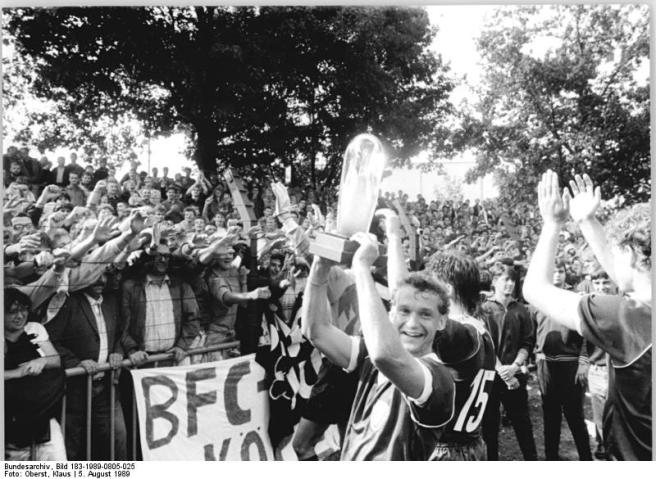
Manipulation of Football in Communist East Germany for political gain is very well documented. Totalitarian regimes often use sport as a means of self-promotion to convey success and strength. In communist Eurasia, the central intelligence services and / or secret police would back a team, almost always exclusively with the moniker ‘Dynamo / Dinamo‘. Under communism teams were often (but not always) linked to one of the national industries with players officially being amateur. You could never call the system “sponsorship”, but a public industrial unit did provide resources and the team did represent the unit, critically acting as a sporting medium for the disputes and tensions seen between industry and state. The idea of the state exercising absolute control over all economic activity is something of a myth; each body did indeed struggle against the central party and powers for their own interests. In the GDR, the Stasi also required a team to succeed in its goals of restoring faith and winning public support.
That team was SG Dynamo Dresden, but the ruling Sozialistische Einheitspartei Deutschlands felt the most successful state-backed team should naturally be based in the capital. This surprisingly common totalitarian practice invariably comes at the expense of players and fans. The birth of BFC Dynamo begins in 1964, when SG Dynamo Dresden were forcibly relocated by the SED to East Berlin midway through the season, initially with the name SFC Dynamo, later changed to BFC Dynamo (which changed to FC Berlin as of 1989 before later being renamed BFC Dynamo). Fans of the original SG Dynamo Dresden were distraught. The largest spectating crowds in East Germany had been relieved of their team with little explanation.


BFC Dynamo were effectively a Stasi puppet. And everybody knew it. It serves well as a reminder that totalitarian governments were very much afraid of their subject peoples and that paranoia fueled the Stasi’s interest in seeing their team win. Paranoid totalitarian regimes and a desire for sporting dominance; what comes next? There are several documented cases of the SED overseeing the transfer of the GDR’s finest players to BFC, and even more of downpayments and favours to referees at key games at the end of the season, most notably in the 80s, during BFC’s winning spree (Berlin-based pun not intended). The Stasi simply had to see its team victorious. And what happened when malplay was suspected? The newspapers were simply told what to report. Berlusconi couldn’t hold a candle to these guys.
But all these measures did not convince the people of the legitimacy of the Stasi or of BFC. The puppet was the most hated team of the GDR. As the 70s became the 80s, hooliganism took shape with frequent violence. The paranoid government blamed Western influence. But all attempts to manipulate and control domestic proceedings could not shape events externally; there was no way to hide BFC’s failings in European competition from the people of East Germany. People knew BFC for what it really was and didn’t swallow the propaganda.

1990 and the two countries reunite, as do the East and West German Footballing bodies. Kind of; the Deutsche Turn-und Fußballband ceases to exist and the Deutsche Fußball Band simply takes in all East German teams. The process is painful to East German Football. Firstly, the teams drop to the lower entry-level divisions, secondly, the top players are snapped up by the Western clubs and thirdly, the quality of Football plummets. Over quarter of a cenutry later, the East still has not caught up with the West. The economic shock of reunification put many Eastern Germans out of work and desperate. Meanwhile Football fans saw the utter humiliation of their teams, fueling anger and bitterness. This has been the recipe for epidemic Football hooliganism in East Germany, of which BFC Dynamo is a key figure.
The Pinocchio club. From Puppet to Real Boy. With an aggression problem.
BFC Dynamo.
 From Boothferry To Germany
Very good. Enjoyed that. Berlin is one of the great European cities that I am yet to visit. Must do better.
LikeLiked by 1 person
It’s not known for quality Football. But it offers so much culture and history, and this spills over into the stories of the clubs there.
LikeLiked by 1 person
I think there is unfortunately lot of sloppy sensationalist writing when it comes to BFC Dynamo. I feel that simplifications and sometimes even rumors are reproduced and presented as facts by otherwise competent writers, seemingly without any honest attempt to question, understand or put things in their proper context. Well. Why bother? After all, it’s the Stasi-Nazi-club…. Simon Kuper is surely a great author. But in his book (“Football Against The Enemy”) he writes that “Mielke loved his club and made all the best players in the GDR play for it (one was Thomas Doll, now with Gazza in Lazio.) He also talked to referees, and Dynamo won lots of matches with penalties in the 95th minute.” Let’s discuss those two things. 1.) Erich Mielke “made all the best players in the GDR” play for BFC Dynamo? Really? (You too writes: “There are several documented cases of the SED overseeing the transfer of the GDR’s finest players to BFC”) Then, who were all these players? Any names? Well. Waldemar Ksienzyk came from 1. FC Union Berlin in 1983, Thomas Doll from FC Hansa Rostock in 1984 and Frank Pastor från HFC Chemie in 1984. But all three came to BFC Dynamo after the team they had played for was relegated to the DDR-Liga. That is hardly spectacular. Rather normal I would say. Thomas Doll wanted to go to BFC Dynamo in order to be able to play for the national team (he also had an offer from SG Dynamo Dresden, but chose Berlin). Apart from these three, most of the top-performers of BFC Dynamo in the 1980s came through the club’s own junior team. (Important to say: BFC Dynamo was EXTREMELY privileged when it came to recruiting talent, but in that case, we talk about teenagers who were to be developed in the club’s youth academy, not established players.) BFC Dynamo actually recruited fewer established players from others team in the league than what other clubs did. 2.) BFC Dynamo ”won a lot of matches in the 95th minute”. This is really interesting. I must say, it is quite unclear what source Simon Kuper has for this statement? The DDR-Oberliga was not played behind closed doors. There are TONS of statistics available for the all seasons. It is all out there for anyone to check. I went through ALL league matches played by BFC Dynamo from the 1978-80 to the 1987-89 season (the ten league seasons won by the club). I found only two (!) matches won by BFC Dynamo on extra time: HFC Chemie – BFC on 12 April 1984 and BFC – 1. FC Union Berlin on 5 March 1988. NONE of those matches were won on penalty. (However, BFC Dynamo was awarded a penalty on extra time against HFC Chemie on 12 April 1984). Then, I found six matches equalized by BFC Dynamo on extra-time. Only two of those matches was equalized on penalty: the match against HFC Chemie mentoned above (which is thus counted for twice) and the infamous match against 1. FC Lokomomotiv Leipzig on 22 March 1986. (But the “Shame penalty” has proved to be correctly awarded by referee Bernd Stumpf.) So, we have 8 matches won or equalized on extra time. But only in one of those matches did BFC Dynamo set the final score on penalty. In ten seasons. We are talking about 260 (!) league matches here. (Note: I may have missed one or two.) If anyone find Simon Kupers “ton of matches won in the 95th minute”, please tell me where it is. (Simon Kuper’s picture of BFC Dynamo is further questioned in Emmanuel Hogg’s “Kicking through the Wall”, see page 158-159.). At last. BFC Dynamo had the best team in the 1980s. I’d like to finish with a quote from the well-respected referee Bernd Heynemann (in Leipziger Volkszeitung in 2017): “Der BFC ist nicht x-mal Meister geworden, weil die Schiris nur für Dynamo gepfiffen haben. Die waren schon bärenstark”. Thanks for a great blog! You are doing a great job describing the strange and very fascinating world of East German football. I apologize for spelling errors and massive text. I hope you do not get annoyed by me sharing my thoughts on common (mis?)conseptions of BFC Dynamo. Cheers! Kindest regards. /Erik
LikeLike
(I’d like to correct myself. I went through all league matches from the 1978-79 to the 1987-88 season. And Simon Kuper never wrote “ton of matches”. He wrote “lots of matches”. It was me who incorrectly read “ton of matches”. I’m sorry.)
LikeLike