
With the remaining garlic-covered octopus tentacle between my teeth, I knocked back the final millilitres of Paxaran before indicating to the waiter that I needed the bill. There is always something so impressive about Spanish hospitality staff and their ability to do three things at once, but even so, the typical Basque industriousness was visible in every movement he made. 10.40€ lighter, I bid the patrons farewell and continued my walk Las Llanas, taking care to find some good photo opportunities as I went. Green and black flags hanging outside two bars on the main road indicated the opportunity to get another drink before kick-off, and in no time I found an open door to what I thought was the club shop.
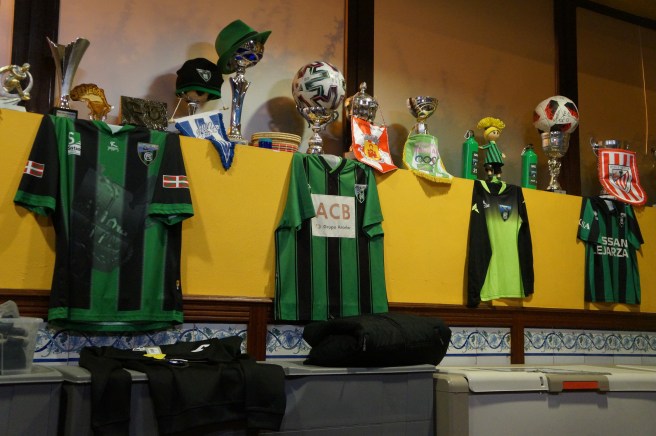
I popped my head through the door and found a row of cotton t-shirts laid out on a wooden table by the entrance. A sign read “T-shirt offer, €9”, and eager for a souvenir, I proceeded into the room only to find nobody else there. Several other tables and clothing racks were stuffed with club merchandise, training wear, accessories and even some retro playing shirts, trophies and memorabilia from years gone by. As I studied the collection, a small voice behind me startled me. “¿En qué te puedo ayudar?” Maria Elena introduced herself as a long-standing employee of Sestao River Club and indulged my desire to take some snaps of her office. “But this is not the club shop, this is the storeroom” she explained, with typical Basque frankness. But can I still buy a t-shirt? “Sí, claro” she explained before turning back to a local father and daughter who were equally surprised to see me there.
The British have played a key role in the evolution of Football in the Basque Country (and in Spain more generally), but nevertheless in 2025 I suspect the Sestao River faithful and their neighbours don’t receive many guiri tourists like me. The small Basque town is a working-class suburb of the magnificent Bilbao – a faithful nucleus of industry in the otherwise stretched, and volatile, Spanish economy. We won’t go into the complex relationship that Euskadi has had with the Spanish state in this post, but safe to say that locals have an inherent, albeit understated, pride in their region’s history. And the beating artery of the Biscay economy has long been the Nervion river; a lifeline for the shipbuilders, steelworks and financiers of yesteryear that divides Bilbao in to and passes the humble Sestao before reaching open water less than 3 km away. Nowadays insurance, banking and the global service economy give the people of Sestao their livelihood, but the town’s working-class identity, and unfamiliarity with tourists, remains.

This may well have explained the reception I got next. Satisfied with my purchase, I crossed the main road and walked back the way I came. With 30 minutes before kick-off I was eager to mingle with more local fans and thus tried the 2 bars I had passed. The first was rammed beyond capacity, so I kept walking and tried the second around the corner. Fan stickers on the doors indicated the club allegiance of its regular, and 3 men stood smoking on the footpath told me it was open and serving punters. The more you go groundhopping around the world, the easier becomes at recognising the “old-school” type who have been there and done with tales to tell from the terrors of the terraces. If you know, you know, and one particular tough-looking nut caught my eye. I’m not a socio, is it okay if I come in? While assertive in his body language and tone, he was incredibly polite. “What is it would you like?” I’m in town for the game and I’d like a drink in a local peña with some fans if that’s okay.
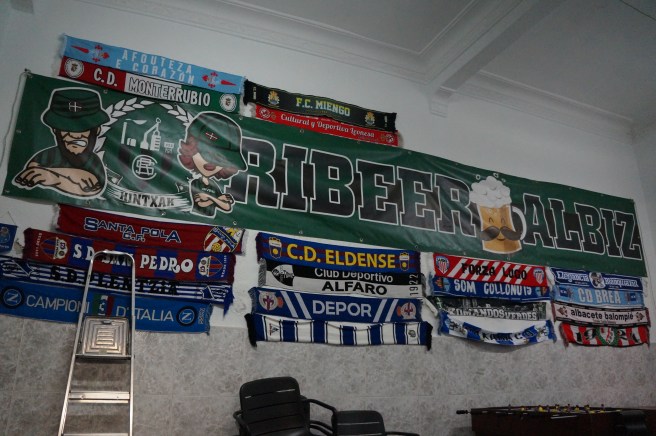
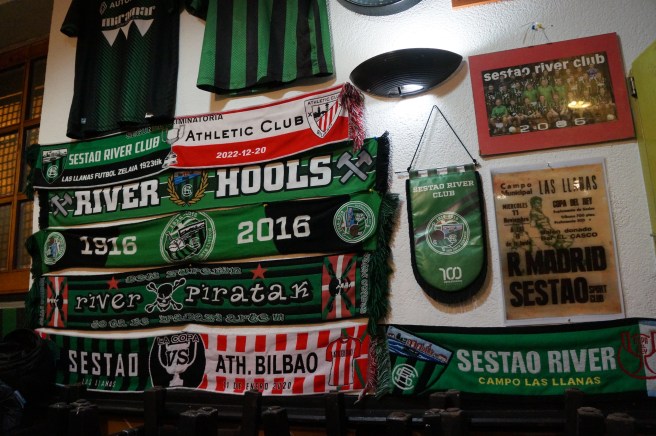
Diego allowed me in and quickly went behind the bar, putting a cold bottle of Estrella Galicia on the counter for me in exchange for a single Euro coin. “This is quite a new peña in the city. We only founded it a few years ago, but we’re very proud of it”. Fan stickers clung to the wooden work surfaces and doorways, while gorgeous retro shirts and posters advertising high profile fixtures lined the walls tastefully. The place was completely full. Having seen more of Spain than most of the Spanish, I gave my compliments, which were well received. “Would you like some fan stickers?”
Much like Diego’s Ribeer Albiz peña (loosely translating as an official fan club), Sestao River Club is young. Founded in 1996, the verdinegros are a stalwart of the 3rd and 4th tiers of the Spanish game. Having never reached La Segunda in its 29 years, River has only competed in regional competition against well-known rivals from Northeast Spain, and with around 2,000 official members (and much larger clubs close by), wild dreams of national glory must necessarily be tempered by realism. Diego took me into the back function room and showed me the collection of scarves from other clubs. “Of course fans of other clubs are welcome in here. We like fraternising with visitors, and all we ask is that they behave respectfully”. With my second beer in hand (this one complimentary), I pursued. So who would you say are Sestao River’s biggest rivals?

Sestao River Club only exists as a consequence of the downfall of Sestao Sport Club. Founded as early as 1906, SSC was a long participant in regional Football and produced many fine young Basque players who went on to play for the region’s larger clubs, including Athletic, Real Sociedad, Alavés and Osasuna. But financial difficulties in the mid-90’s compounded by a miserable run in the leagues resulted in the final curtain-close on one of the most colourful clubs of Biscay Province. But as so often is the case in actual tight-knit communities attached to “smaller” Football clubs (for lack of a better word), the fans broke open their piggy-banks and put their pesetas into a new fan-owned project to allow their Football culture to continue, flourish and prosper. In 1996 Sestao River Club was born and very quickly got back up to the Tercera División by 1999. This continuity in fan-culture has allowed Sestao Sport Club’s great enmity with its neighbour to survive. “The only fans we have ever had a problem with are Barakaldo”.
Tensions have been high recently with most notable violent episodes between factions of rival fans in 2008 and 2022 on the same main road I had walked along to get to Las Llanas. “Listen, if Barakaldo played here tomorrow, and some of their fans wanted a drink, they’d be welcome in my peña – so long as they behave themselves. But I don’t think that is very likely”. Far from being politically motivated (i.e. two opposing supporter groups allied with ideologies on opposing sides of the political spectrum coming to blows), it seems that the nature of the feud between Barakaldo and Sestao River is one of eagerness to be the local top-dog, or at least the brightest star in the shade of Athletic. “To be honest, we think they are a bit pathetic. I mean, Barakaldo has a way bigger population. Their ground has bigger terraces and they have more money. But I mean, the number of socios is not that different. What does that tell you?”
By this point, Diego and his colleagues had stopped accepting my money entirely. Eager to teach me more about the local fan culture, he introduced me to several fans who flitted in an out of the bar. “This is Luiz, he is the capo of our grada.” The young lad had a gravelly voice that matched the lifestyle of someone who enjoyed a weekend of drinking and shouting for 90 minutes, and Luiz was just as accommodating. “No no, come down to our end. You’ll come through the same entrance with us, but then just keep walking down to the end. Don’t waste your time going to your seat, you’ll enjoy it way more with us.” With my fresh glass of calimocho (a surprisingly enjoyable 50-50 mix of red wine and Coca-Cola, consumed in quantities by late-teens of the Basque Region looking to get drunk without paying too much), I toasted the fans around me and asked the obvious question.
“No not really. We get on very well with them and there is actually a lot of support in Sestao for that club. They are Basque, they are successful, they are big and they are known around the world because they are Basque. They are not a rival.” And presumably Sestao River is part of the Athletic Cantera also? “No no, we are independent”. It is a word that carries a lot of weight in the Basque Region.

“Listen, there is a lot of support for Athletic here. Half of these guys tonight will be in the San Mames this weekend. What’s the need for comparison? We’re a smaller club, we like it that way, we like our nights in our stadium, but we also like having a big club that can represent the Basque Country successfully.” By this point, fans were heading out as kick-off approached. I bid Luiz adieu and raced to finish my rum and coke as Diego spoke. “We’re fans of Athletic, but we’re also fans of River”. I asked the obvious follow up question. I guess a Biscayan club that is part of the Athletic cantera is obviously going to have a lot of apathy for Los Leones, right?
Much is made of the system of talent scouting employed by Athletic Bilbao. Sycophants and romantics, engineers and pragmatists applaud the way in which the biggest club of the Basque region invests in local talent and works with smaller clubs from the region to produce players year after year that allow Athletic to continue to claim that only Basque players have worn the shirt since 1912. Detractors, fans of rival teams, purists and analysts point out the objective looseness whereby Athletic describes the athletes on its books as Basque – former player Aymeric Laporte is a French national of Euskera parentage who was born the wrong side of the Pyrenees. Does that make him Basque? You tell me. But critics of Athletic go one step further and accuse the club of aggressively hounding all other Basque entities and robbing them of their talent.
I see this as unfair and a cheap criticism that comes predominantly from Sociedad and Osasuna fans who would like to see their clubs win more. The only two semi-pro clubs directly under the Athletic umbrella are Bilbao Athletic and CD Basconia, located in satellite towns Lezama and Basauri respectfully. Other than that Athletic employees a large number of talent scouts who work with do the work of identifying local youth talent that could be brought to the club. And as long as this process is not exploitative of minors, its difficult to see why this is a practice that should be criticised. Nevertheless, many smaller clubs in the Biscay Province are assumed to be cooperating with the Athletic talent scouting network, at least to some degree. But Diego quickly corrected. Giving me a can of cold lager to sneak into the ground via my rucksack, he made his feelings very clear. “We are not affiliated with Athletic. Fans, but not in any way part of their structure. Sestao River is independent”. It is a word that carries a lot of weight in the Basque Country.
The names of individuals mentioned in this blog post have been changed to protect their identity.
 From Boothferry To Germany