
The platform was entirely empty as I stepped out. A single stairway led to an uncovered footbridge across the trainlines and towards the exit of the train station. As I climbed, the regional train shuddered into motion and continued its routine journey along the coast. A few moments later and silence resumed. It’s true, I was arriving in the town several hours before kick-off. But as I passed through the small train station and onto the main road, the silence was unnerving. With my backpack hoisted high on my shoulders, I began the ascent uphill to the stadium.
Away from the predictable duopoly at the top of La Liga, Spanish club Football has been remarkably interesting in the past decade. Many pioneering giants of the game have fallen foul of financial woes and appalling management, and the abundance of big names in La Segunda División (and even lower) tell the story. Real Oviedo, Málaga CF, Deportivo La Coruña, Real Zaragoza and El Racing surely deserve eternal Erstligist status for their contribution to the Spanish game, but in their places have been taken by smaller, humble clubs run by astute managers capable of spotting a good deal and with the patience to wait their turn in La Liga limelight. Rayo Vallecano are having an excellent spell at the moment. Getafe and Leganés are also names you could probably add to that list, and Cádiz are also a side that probably found itself in the top division as a consequence of little more than good stewardship while other major clubs self-destructed and fell out of the first division. But there is one La Liga stalwart whose rise to the top flight is even more obscure.
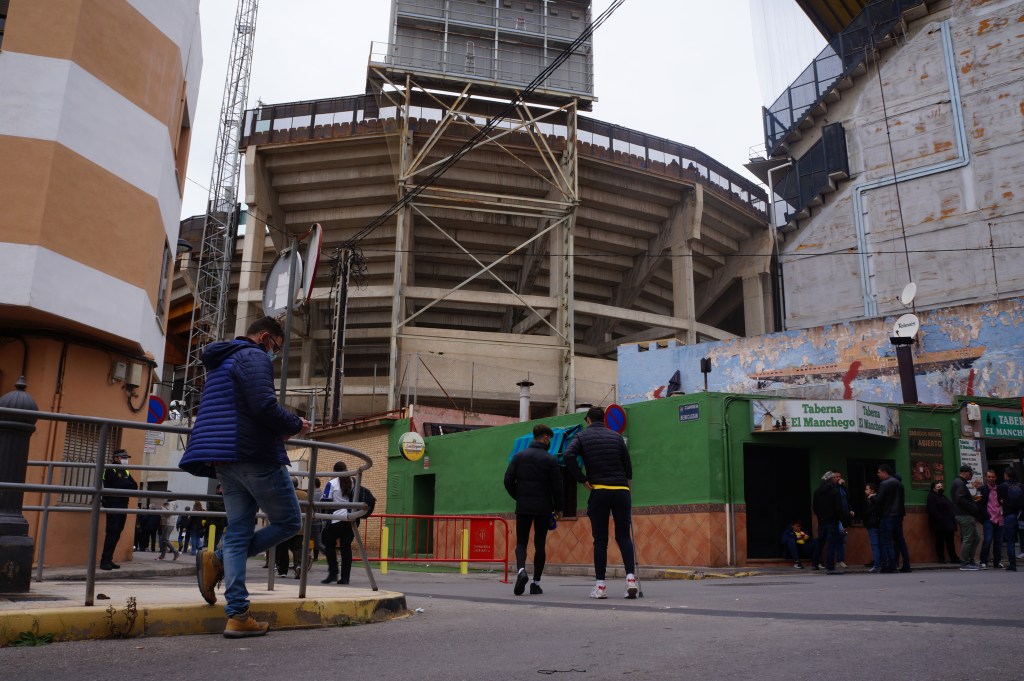
After a brief pause for a revitalising hair of the dog in a small tavern, I finally reached my destination – a lurid bright yellow wall in a clearing. The day’s visitors had arrived well ahead of kick-off. RCD Espanyol is a club known for travelling well in Spain, and the favourable kick-off combined with the short drive down the east coast (short by Spanish standards) facilitated an even better following than usual. In spite of a looming relegation dogfight, the blanquiazules were making all the noise as I squeezed past and joined the line for a ticket for entrance into the Estadio de la Cerámica – Villarreal Club de Fútbol’s high tech, 23,500 stadium that can fit over half of the town’s population (approx 51,000)
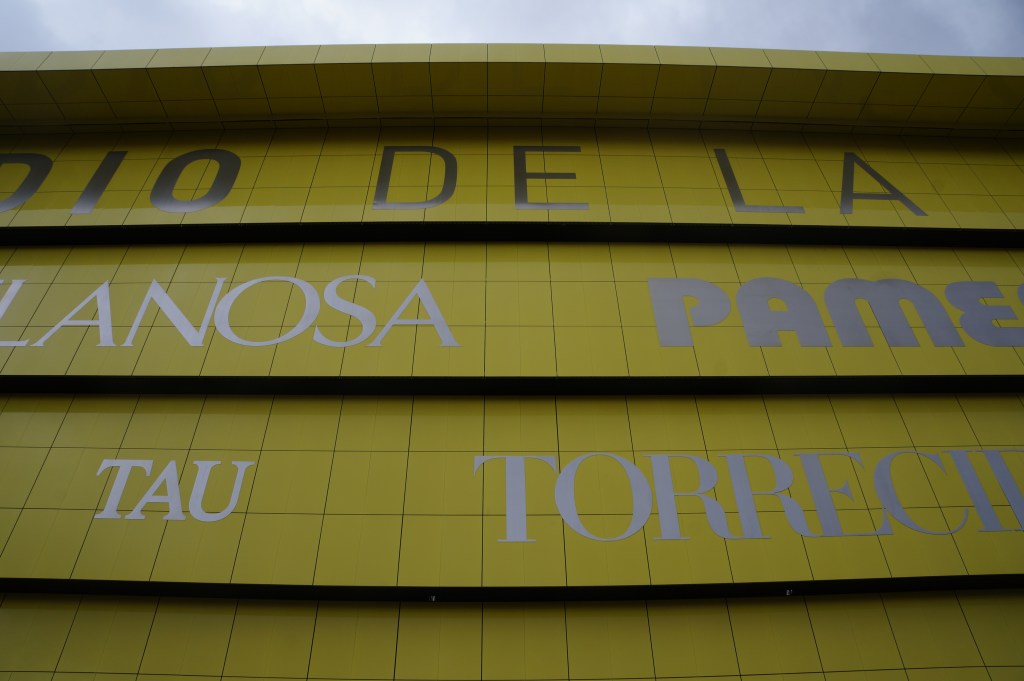


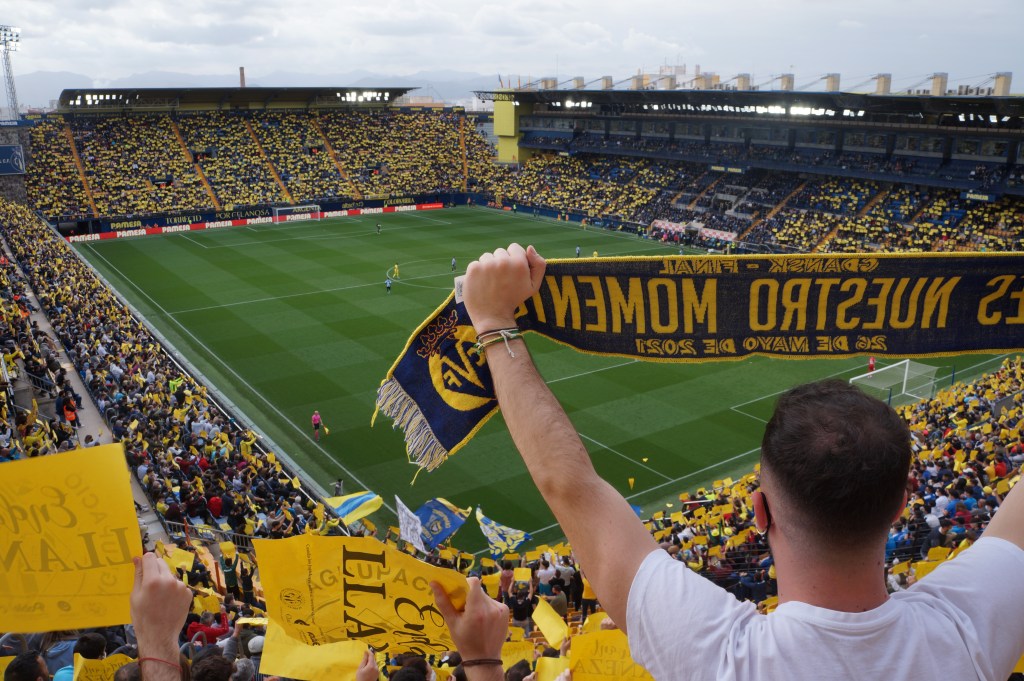
It is a club that is revelling in its own success. Founded in 1923, the club first swapped their black and white kits for yellow shirts in 1947 as they bobbed up and down between lower leagues for the whole of the 20th century. The 60’s Spanish pop group “Los Mustangs” cover of the Beatles’ “Yellow Submarine” inspired the nickname of the club that never seemed to occupy a single division for long, and now Villarreal fully embrace the moniker (the official club mascot is “Groghet” – “Little Submarine” in Catalan). But for all the relegations and promotions, the Yellow Submarine had never raised its periscope into the rarefied airs of La Liga – until the 1998/1999 season when it finally made its first division debut. Since then, Villarreal has competed in Spain’s top flight for every single season excluding 2. It has finished as high as 2nd in the league (finishing behind FC Barcelona in 2008). It reached the semi-finals of the UEFA cup during only its third season in La Liga. It reached the semi-final of the Champions League in 2006. And the Yellow Submarine famously lifted silverware by defeating Manchester United on penalties in the final of the 2020/2021 Europa League in Gdansk.
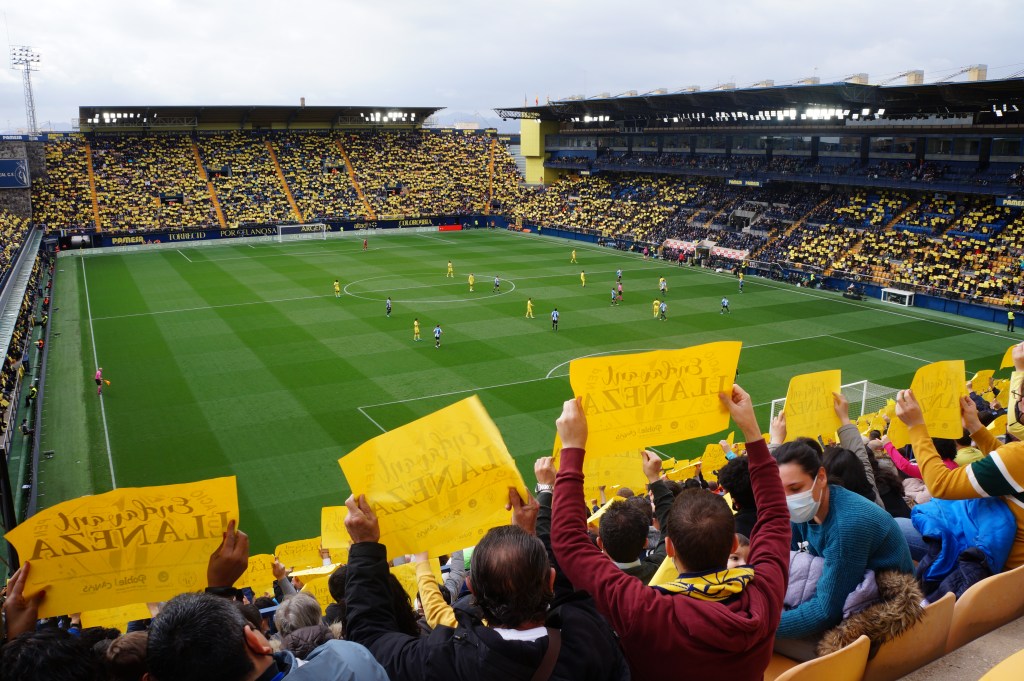
Ticket securely tucked into my pocket, I ambled around the ground in an attempt to get more shots of the stadium’s exterior. The narrow streets of the small town and the passing fans made it tough to get a clean photo, at which point I gave up and went to buy a souvenir scarf from the club gift shop. A few more drinks in, I eventually made for the eastern entrance and found a seat high in the corner to the left of the away support and behind a small group of fans with a few flags and a drum. As the players walked out onto the pitch, all Villarreal supporters raised yellow A3 sheets of paper to create a wall of yellow all around the ground. But for the duration of the game, it was the travelling Espanyol supporters who made the most of the atmosphere, cheering their boys on until the bitter end despite a 5-1 thrashing.
The truth is that in spite of its on-pitch fortunes and undeniable success, in the eyes of many Villarreal has not yet reached the statum of “Big Club” in Spain. The obscure small-town club has done very well for itself, but it lacks a clear, established support group and fan culture. The club only has 26 registered peñas (fan groups). Valencia CF has over 500, and recent La Liga clubs with smaller budgets than Villarreal also have larger and more active fan bases (Cádiz has 74, Granada 35, Levante boasts 52, Mallorca claims 54 and Osasuna apparently has 38). In spite of the small group of young man waving flags and beating the drum, Villarreal also does not appear to have an active ultra scene. A group calling themselves “Borratxots” (“The Drunks”) appear to have been active in the early 2000’s but their website has not been updated since 2010. It is down the road where we find a grump neighbour shaking their head at the young upstart’s meteoric success.


The town of Villarreal is located in the Castellón of the Comunitat Valenciana, some 60km up the coast from the eponymous capital of the region on a strip of flat coastal land and the rough upland terrain of the Maestrazgo that generals of old feared crossing with their armies. The first mention of a settlement here in the history books dates back to 1252 following the capture of the land by the Kingdom of Arragón from the Moors of Northern Africa. Castellón is therefore not one of Spain’s historic cities, but it is home to a thriving industry that is important for the country.
Several sites dotted around the Maestrazgo are known for their abundance of high quality clay, and Castellón’s location on the banks of the river Mijares that comes down from these highlands as well as close to the Mediterranean Sea (for easy export) has allowed the ceramic industry to thrive here. In a global industry worth reportedly €3.69 billion in 2008, Spain is the second largest player and the bulk of the Spanish ceramic industrial activity takes place in Castellón where ceramic factories account for 23% of the province’s actual GDP. In keeping with Simon Kuper and Stefan Szymanski’s theory of why industrial cities produce greater Football teams, the young working class population of Castellón have take pride in the fortunes of their club CD Castellón against teams from the rest of Spain. The club acts as a pillar of their community and a focal point for civic pride.
And as such, the CD Castellón fan scene is far more established than its bright yellow counterpart. Though founded after Villarreal CF (in 1929, 6 years later than the Yellow Submarine), CD Castellón has spent a total of 11 seasons in La Liga, with 5 of those appearances coming in the 1940’s and the most recent being in the 1990/1991 season. The club appears to have 3 leading supporter groups that are active online. La Linea Albinegra is a very vocal fan group that is strictly apolitical and opposes violent conduct in all forms in Football. Ultras Castellon is a young ultra group that is very active in spite of very little online presence. But the most well established ultra group of Castellón is the Barricada Albinegra. Founded in 2005, this left-leaning ultra group refers to the club in Catalan (referring to it as Club Esportiu Castelló) and is pro-Catalan-independence, in the process making strong adversaries of the Boixos Nois of FC Barcelona, the Frente Blanquiazul of RCD Espanyol and the Yomus of Valencia CF. Yet the Barricada Albinegra and all of CD Castellón fans find their biggest rivalry directly across the Mijares river. The Barricada Albinegra actually use the year 1922 in a lot of their materials – the year before the establishment of Villarreal CF (in an attempt to delegitimise the club’s support).

So if Castellón is the older, more established and bigger club with regards to fanbases, why has Villarreal CF emerged as the more successful club in the 21st century? The yellow submarine’s success largely owes itself to one man; Fernando Roig. Born on the 25th of June 1947 in Pueblo Nuevo on the outskirts of Valencia, Fernando Roig comes from a privileged background. His family founded a chain of butchers (Carnicas Roig) as well as the national supermarket chain Mercadona, and since 1997 Fernando has been the active president of Pamesa; the 5th largest ceramics manufacturer in the world with a reported turnover of €1.186 million in 2022. If this name is familiar to you, it is probably because of the fact that since 2013 Pamesa Ceramica has been the principle shirt sponsor of Villarreal CF. But this sponsorship deal followed Fernando’s purchase of the club in 1997.
In an interview with Diario AS in 2017, Roig claimed he has spent over €190 million on the club that he originally purchased for €432,000. His second investment in the club was in its infrastructure. The ground was rebuilt between 2004 and 2005 and had its name changed from “El Madrigal” to “Estadio de la Cerámica” in 2017 (another nickname for the club is los azulejeros; “the tilemakers”). Furthermore the club now has a very successful talent incubation system that allows it to develop young players instead of purchasing them. It is difficult to see how Villarreal could have ever reached the heights of Europa League victory without Fernando Roig’s vision, but in truth, his actions are well in keeping with those of his family. The Roig business empire has a long history of investment in sport in the Comunitat Valenciana.
Fernando’s brother Francisco was the president of regional big-shot Valencia CF from 1994 to 1997 and now owns a 38% stake in Alicante’s Hércules Club de Fútbol (on the other side of Valencia from Castellón). Pamesa Cerámica is also the title sponsors of Voleibol Teruel and Valencia Basket – a sports team conveniently owned by brother Juan Roig who also went into business with former motorcycle racer Jorge Martinez Aspar in the Aspar Team motorcycle racing team that has its HQ at the Aspar Circuit 20km south of Valencia city. This was the same Jorge Martinez Aspar that Fernando Roig partnered with to bring the Formula 1 Gran Premio de España from Barcelona to Valencia. The two men created the holding company Valmor Sport Group that pitched the idea to then Formula 1 president Bernie Ecclestone in 2007. The first grand prix to be held on the street circuit around Valencia’s port took place in 2008, but after 5 years, a lot of criticism from fans and an untenable financial situation, the project collapsed, leaving a fiscal blackhole the size of €300 million in the Comunitat de Valencia‘s pocket that the taxpayer had to bailout (as of 2021, creditors were still owed €42.9 million). But what perhaps hurts CD Castellón fans the most is the fact that Fernando Roig originally planed all this for their club.


The owners of CD Castellón did not look at the bid from the Roig family as convincing back in the 90’s and rejected the offer, not seeing the family’s business credentials as proof of genuine care for the club or for the hardworking people of Castellón. As a consequence, Fernando simply hopped across the river and invested a small fortune to build a new great Spanish team in a tiny satellite town of their city. The rest, as they say, is history.
Though Fernando is approaching 80, he and the Roig family more generally clearly have no desire to slow down their businesses nor to take a step back from their portfolio. It is easy for the layman Football fan to look at business-folk who invest in sport with distaste. And while there is certainly no shortage of flashy entrepreneurs and tycoons getting into the sport for the wrong reasons, the scale and scope of the Roig family investment in sport in the Comunitat de Valencia is indicative, I think, of them doing it for right reasons. Fernando has indeed been caught up in legal complications and scandal that I cannot comment on here. But his repeated investment in local sport seems to hold up to the scrutiny from cynical fans. It only stands to see if his astute investment in the club infrastructure will result in a loyal, strong, active supporter culture surrounding Villarreal beyond his inevitable demise.
This could be the start of something new. Or, like a beautiful but delicate ceramic tile, it could shatter as soon as the grip begins to loosen.
 From Boothferry To Germany